When Is the Best Time to Visit Glacier National Park?
The best time to visit Glacier National Park is from late July to mid-September. By then the Going-to-the-Sun Road is open from end to end, the high-country trails have lost most of their snow, and the park is fully running. If you want fewer people, aim for September. If you want wildflowers, aim for late July and August.
Glacier is not like parks you can visit on any weekend. The park sits on the Continental Divide in Montana, and its most famous road and trails are buried in snow for much of the year. Choose the wrong month and you may drive all the way there only to find Logan Pass closed. This guide breaks down each season so you can match your dates to what you actually want to do.
The Short Answer: Best Time by Goal
| If you want... | Go in... |
|---|---|
| Every road and trail open | Late July to early September |
| Wildflowers and snow-free trails | August |
| Fewer crowds with good weather | Early to mid September |
| Fall colors | Mid September to early October |
| Quiet and lower prices | May and early June (with limited access) |
| Snow and solitude | November to March (winter gear needed) |
Why Timing Matters So Much in Glacier
Two things shape every Glacier trip: snow and the Going-to-the-Sun Road.
The road is about 50 miles long and crosses the Continental Divide at Logan Pass, at roughly 6,646 feet. Plowing starts in early April, and the park says Logan Pass usually opens somewhere between mid-June and early July, with snowstorms and avalanches able to push that back. In 2026 the full road opened to vehicles on June 22, which is on the early side because of a mild winter. The park cannot predict the date in advance.
Even after the road opens, the trails lag behind it. On opening day in 2026, the Highline Trail from Logan Pass was still closed because of snow. That is why a trip in the second half of June can feel disappointing if your plan is built around high-country hikes.
Month-by-Month Guide
| Month | What to expect | Best for |
|---|---|---|
| April to May | Plowing underway; Logan Pass closed; lower areas open | Quiet visits, waterfalls, cycling |
| June | Road opens mid-June to early July; snow lingers up high | Fewer crowds, lower valleys |
| July | Peak season; shuttle runs; most trails open as snow melts | Hiking, boat tours, long days |
| August | Wildflowers and snow-free trails; busy | Hiking and photography |
| September | Crowds ease; cooler days; color begins mid-month | Best balance of access and space |
| October | West side color peaks; road closes around mid-month | Fall color, quiet |
| November to March | Deep snow; most services closed | Snowshoeing, solitude |
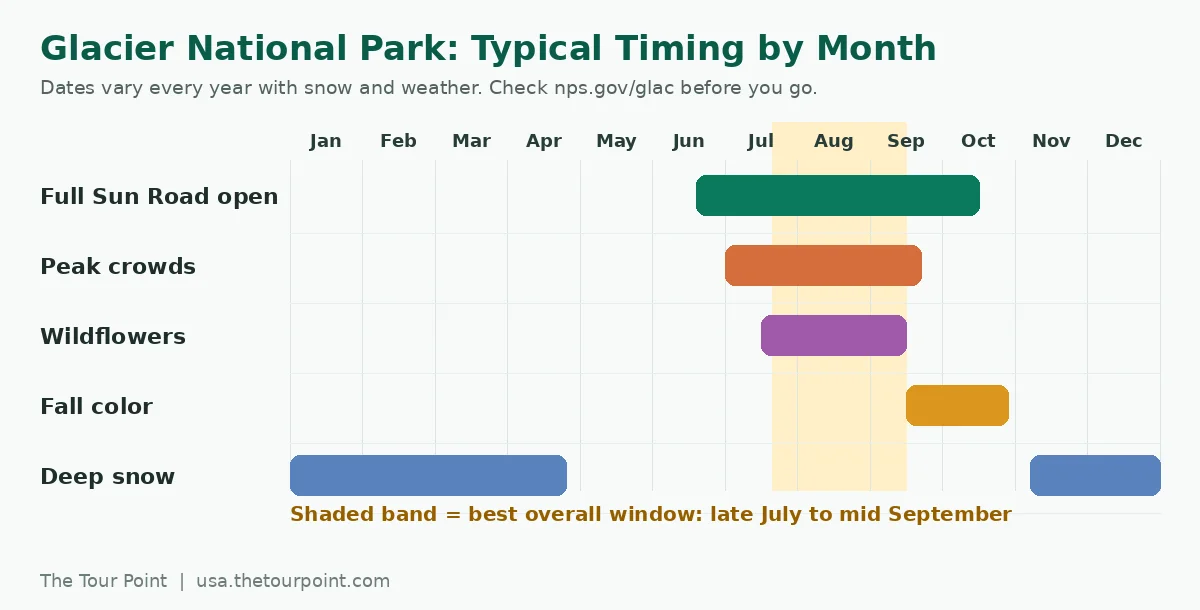 Typical timing by month. Exact dates change every year with snow and weather.
Summer (Late June to August)
Summer is the classic Glacier season, and for good reason. Typical highs run around 25°C (77°F) with cool nights near 6°C (43°F), the full road is open, and shuttles, boat tours and lodges are running.
Early July is the first realistic window for the high trails, but snow can still linger on some routes. August is the sweet spot for flowers and snow-free hiking. Expect crowded trailheads and full parking lots. The most useful habit is to arrive early. Getting to popular trailheads before 8 am makes a real difference in how your day goes.
The trade-off is simple: summer gives you the most access, and you pay for it in crowds. Most visitors come between June and September, so book lodging and campgrounds well ahead.
September: The Quiet Sweet Spot
For most visitors, the best single window is early to mid September. The crowds thin out, the roads and most services are still open, and the weather is cooler but still comfortable for hiking. Fall color begins in mid-September, and on the west side of the park it tends to peak around mid-October.
The risk is weather. Early snow can arrive at high elevations, and a storm can close the upper part of the road. Pack layers and keep your plans flexible.
Fall (Late September to October)
Fall is beautiful and quiet, but it is a gamble for road access. The Going-to-the-Sun Road typically closes to through traffic around mid-October when snow returns, which is also when west-side color tends to peak. If your main goal is driving over Logan Pass, September is safer than October.
Average highs in fall drop to around 12°C (54°F), with nights near freezing.
Winter (November to March)
Winter in Glacier means deep snow and very cold weather. Highs hover around freezing and lows fall to about -6°C (21°F) in the coldest months. Many roads and facilities close, so this season suits snowshoeing and people who value solitude. It is not a good choice for a casual first visit.
Spring (April to Early June)
Spring is the low season. You get quiet roads, lower accommodation prices outside the park, and good waterfalls from snowmelt. You do not get Logan Pass. If you visit in May, treat it as a lower-valley trip, and stay in a nearby town such as Columbia Falls, Kalispell or Whitefish for more choices.
What's New for 2026: Reservations, Shuttle and Fees
- No vehicle reservations. For 2026 the park dropped the timed-entry vehicle reservation system used in recent years. That covers Going-to-the-Sun Road, Many Glacier, Two Medicine and the North Fork.
- Logan Pass parking limit. A 3-hour parking limit started on July 1, 2026, and overnight parking is not allowed there except for permitted backcountry users and Granite Park Chalet guests.
- Ticketed shuttle. The Logan Pass shuttle ran from July 1 to September 7 in 2026 and needs a reserved ticket through Recreation.gov with a $1 processing fee per rider.
- Vehicle size limit. Vehicles longer than 21 feet or wider than 8 feet, including mirrors, are not allowed on the middle section of the road between Avalanche Creek and Sun Point. Most rental RVs are too big.
- Entrance fee. $35 per private vehicle for 7 days from May to October, and $25 from November to April.
- Extra fee for international visitors. Since January 1, 2026, visitors aged 16 and older who live outside the United States pay an additional $100 per person at Glacier, on top of the standard entrance fee, unless they have a Non-Resident Annual Pass, which costs $250. If you plan to visit several of the eligible parks, such as Yellowstone, Grand Canyon or Zion, the annual pass can work out cheaper.
Tips for Planning Your Visit
- Start early. Reach trailheads and parking areas before 8 am in summer.
- Have a backup plan. Popular areas fill up, and weather can close trails. Pick a second option for each day.
- Pack layers. Even in August, Logan Pass can be cold and windy. Snow can remain beside the road in early summer, and the park discourages walking on it.
- Carry bear spray and know how to use it. Glacier is bear country, and bears are most visible in spring and fall.
- Download maps offline. Cell service is limited in most of the park.
- Check smoke and fire conditions. Wildfire smoke can affect views in late summer in some years.
So, When Should You Go?
- First-time visitor who wants the full experience: late July to early September.
- Want the best mix of access and quiet: the first half of September.
- Chasing wildflowers: August.
- Chasing fall color: mid-September, with a backup plan for road closures.
- Prefer solitude and don't mind snow: winter or late spring, with lower expectations for access.
What is the best month to visit Glacier National Park?
August is the best month for full access, flowers and snow-free trails, but it is also busy. September is the best month if you want fewer crowds and still-good access.
When does the Going-to-the-Sun Road open?
Logan Pass usually opens between mid-June and early July, depending on snow. In 2026 the full road opened to vehicles on June 22. It typically closes around mid-October when snow returns.
Do I need a reservation to visit Glacier in 2026?
No vehicle reservation is required anywhere in the park in 2026. You still need an entrance pass, and the Logan Pass shuttle requires a ticket if you want to ride it.
How much does it cost to enter Glacier National Park?
The standard fee is $35 per vehicle for 7 days from May to October. Visitors aged 16 and older who live outside the US pay an extra $100 per person in 2026, unless they hold a Non-Resident Annual Pass.
When is the best time to see fall colors in Glacier?
Colors begin changing in mid-September, and the west side tends to peak around mid-October. Be aware that the Going-to-the-Sun Road can close around that same time.
Is Glacier National Park worth visiting in winter?
It can be, if you are prepared for deep snow and cold and enjoy activities like snowshoeing. Most roads and services are closed, so it is not ideal for a first-time visit.
How many days do you need in Glacier National Park?
Three days is a good minimum to see the highlights without rushing, and a week lets you do several longer hikes and explore areas beyond the main road.
Planning your dates is the biggest decision you will make for this trip. Pick your month, check the official road and trail status a week before you go, and keep one flexible day in your schedule for weather.