
Dog Breeds Banned in Australia: Full List and Rules by State (2026)
Five dog breeds are banned from being imported into Australia: the Dogo Argentino, Fila Brasileiro, Japanese Tosa, Perro de Presa Canario and American Pit Bull Terrier. Wolf-dog hybrids are also not allowed in. The dog breeds banned in Australia are listed under customs law, and each state and territory then has its own rules for restricted dogs that are already in the country.
If you are planning to move to Australia with a dog, or you are simply curious about why some breeds are treated differently, this guide explains the full picture. You will find the list of banned breeds, how mixed-breed dogs are treated, the difference between a federal ban and state-level restrictions, and what to check before you bring a pet.
What Dog Breeds Are Banned in Australia?
According to the Australian Government's Department of Agriculture, five pure breeds cannot be imported into Australia under the Customs (Prohibited Imports) Regulations 1956. The same list appears on the Australian Border Force website, under the heading of dangerous breeds of dogs.
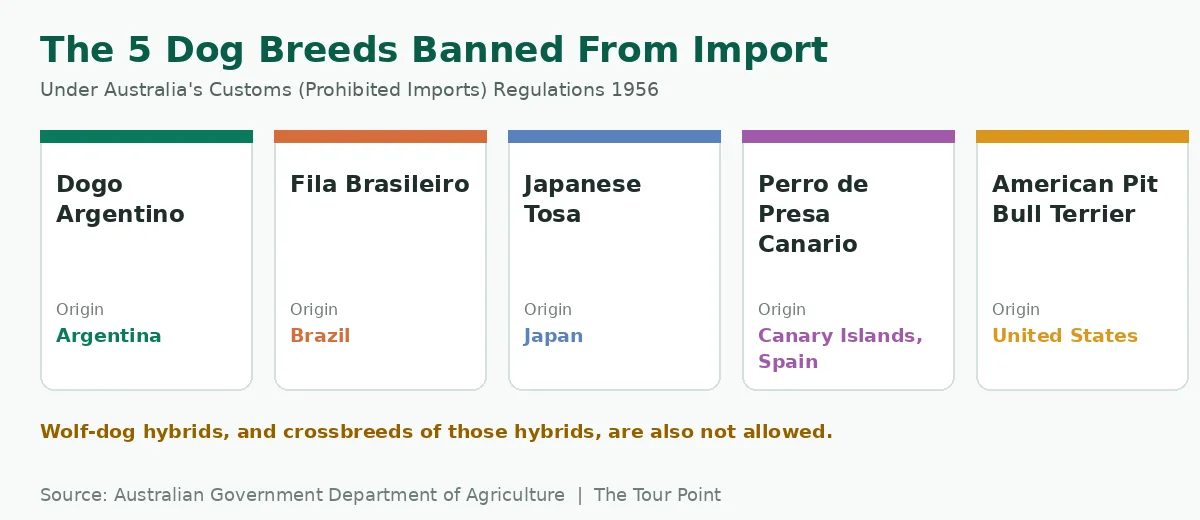 The five breeds banned from import into Australia, per the Department of Agriculture.
The five banned breeds are:
- Dogo Argentino. A large, muscular white dog developed in Argentina.
- Fila Brasileiro. A big guard-type dog from Brazil.
- Japanese Tosa. A large dog from Japan, originally bred for dog fighting.
- Perro de Presa Canario (Presa Canario). A powerful dog from the Canary Islands, Spain.
- American Pit Bull Terrier (also called Pit Bull Terrier). A breed developed in the United States.
These breeds are generally described as dogs that were bred for fighting or guarding. According to immigration advisers, successive Australian governments have taken the view that allowing more of them into the country poses an unacceptable risk to public safety. There is no permit or exemption that lets a banned breed in, and normal measures such as vaccinations or quarantine do not change that.
Wolf-Dog Hybrids and Other Dogs Not Allowed
Besides the five breeds above, Australia does not allow domestic and non-domestic hybrid dogs. This mainly means wolf-dog crosses. According to the Department of Agriculture, the list is not limited to these examples, but it includes:
- Czechoslovakian wolfdog (Czechoslovakian Vlcak)
- Saarloos wolfdog (Saarloos wolfhound)
- Lupo Italiano (Italian wolfdog)
- Kunming wolfdog (Kunming dog)
Any crossbreed offspring of these hybrids is also not allowed. These restrictions come from environmental protection law and are handled by the Department of Climate Change, Energy, the Environment and Water (DCCEEW). If you own a hybrid that is not on the list, the department advises contacting it directly for a case-by-case answer.
Hybrid cats, such as Savannah cats, are also not allowed into Australia, according to current pet-import guidance.
Banned vs. Restricted: How the Two Layers of Rules Work
One reason people get confused is that Australia has two separate sets of rules. The first is a national import ban. The second is a set of state and territory laws about owning certain dogs once they are in the country.
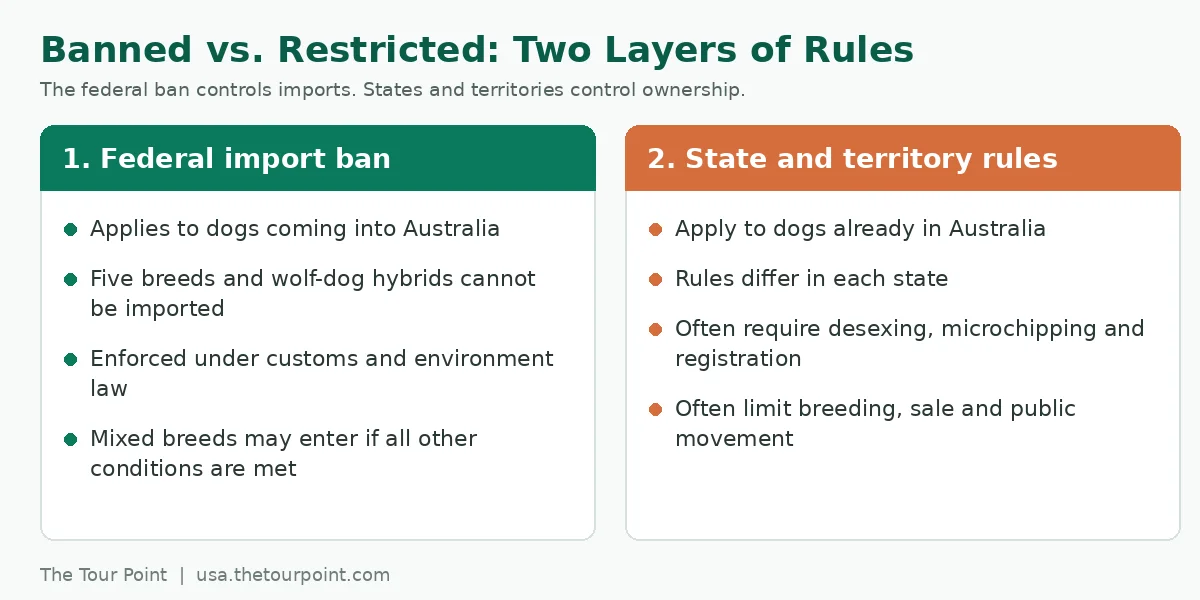 The federal ban controls imports, while state and territory laws control ownership.
The federal ban decides which dogs can come in. It means that the number of these dogs in Australia is limited to those already there, and it stops new ones from arriving.
State and territory laws deal with dogs that are already in the country. In several states, these are called restricted dogs, and the list of restricted breeds mirrors the federal import ban. Owners must follow special rules, which often include desexing, microchipping, registration, limits on breeding and sale, and rules about muzzles and enclosures. Separately, any breed can be declared dangerous or menacing if it attacks or threatens a person or another animal.
Dog Breeds Banned in Australia by State and Territory
Because each state writes its own laws, the details vary. The examples below come from official or council sources, but rules change and councils apply them differently, so always confirm locally.
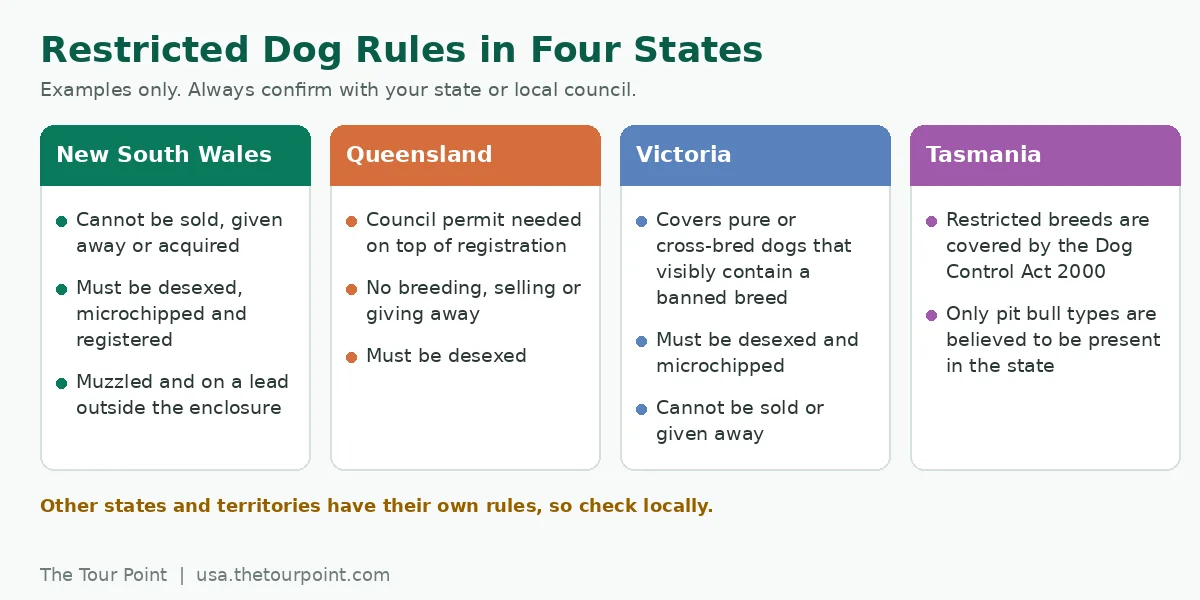 Restricted dog rules in four states. Always confirm with your state or local council.
New South Wales
In NSW, restricted breeds can no longer be sold, given away or acquired, according to local council guidance. The state's restricted dog rules say it is an offence to sell, advertise, give away or transfer ownership of a restricted dog. Owners who already have one must keep it microchipped, registered and desexed.
NSW also requires that a restricted dog wear a muzzle and be securely leashed outside its enclosure, and that it is supervised by an adult. You can read the full list of control requirements for restricted dogs on the NSW Office of Local Government site. The NSW restricted list matches the breeds prohibited from import, and it also covers their offspring.
Queensland
In Queensland, restricted dogs are the breeds whose import is prohibited under the Customs Act, plus any dog declared restricted. The Cairns Regional Council explains that these breeds are included in what the state calls regulated dogs.
Under the Animal Management (Cats and Dogs) Act 2008, restricted dogs need a permit in addition to registration. Legal summaries also say owners must desex the dog, keep it muzzled in public and may not breed, sell or give it away.
Victoria
Victoria uses a different approach to identification. The state defines restricted breed dogs as pure or cross-bred dogs that fit an approved standard, which includes the American Pit Bull Terrier, Perro de Presa Canario, Dogo Argentino, Japanese Tosa and Fila Brasileiro. Councils describe them as dogs that visibly contain any of those breeds.
According to Agriculture Victoria, restricted breed dogs must be desexed unless a vet certifies that they cannot be, and a declared restricted breed dog cannot be sold, given away or transferred. Victoria's rules have changed over the years, and older council pages still say these dogs cannot be registered, so check the latest official page.
Tasmania
Tasmania covers restricted breeds in its Dog Control Act 2000. The state government's restricted breed FAQs note that of the banned breeds, only American pit bull terrier types are believed to be in the state.
Other States and Territories
Western Australia, South Australia, the Australian Capital Territory and the Northern Territory each have their own laws on dangerous and restricted dogs. Western Australia, for example, regulates restricted breeds under its Dog Act 1976. If you live in or are moving to one of these places, contact the local council or state agriculture or local government department.
What About Mixed-Breed Dogs and Look-Alikes?
Mixed-breed dogs are generally allowed into Australia if they meet all the other import conditions, according to the Department of Agriculture. However, the department also notes that if an imported dog is later identified as possibly being a prohibited breed, the Department of Home Affairs may investigate.
This matters because breed identification is not always simple. A dog that looks like a pit bull type may carry the ancestry of other breeds, and some dogs labeled as a certain breed may not be. Victoria's rules ask whether a dog fits an approved standard or visibly contains a restricted breed. NSW lets councils declare a dog restricted and has a process for assessing temperament in some situations.
Pure Staffordshire-type breeds are separate from American Pit Bull Terriers, and they are not on the list of banned breeds. If you are unsure about your dog's breed, ask a vet for a written opinion and keep your documents, such as pedigree papers, before you travel or move.
Why Does Australia Ban These Breeds?
The official reason is public safety. The five banned breeds were developed for fighting or guarding, and successive governments have taken the view that they pose too great a risk to the public and to other animals.
The policy has critics. Opponents of breed-specific laws argue that a dog's behavior depends more on how it is raised and trained than on its breed, and that laws should focus on owners and on dogs that actually show aggression. Victoria held a parliamentary inquiry into its breed-specific rules, which received 502 written submissions, and the state government responded by seeking to allow registration of restricted breed dogs while keeping other restrictions.
Supporters of the restrictions say the laws reduce the number of these breeds in the community over time and add safeguards for dogs already in the country. Both sides agree on one point: owners of any large, powerful dog carry a heavy responsibility.
Moving or Traveling With a Dog to Australia
Even if your dog is not a banned breed, bringing a pet to Australia takes careful planning. Dogs must meet strict biosecurity conditions, and the steps depend on which country the dog is coming from. The Department of Agriculture publishes separate step-by-step guides for different categories of countries.
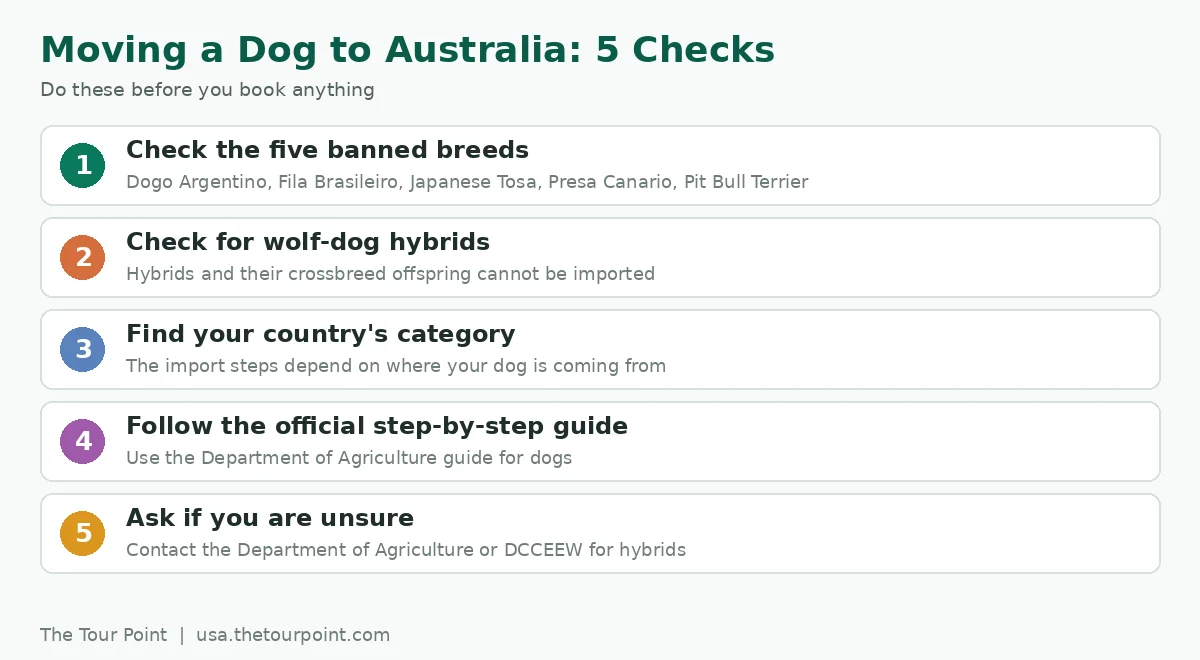 Five checks to complete before you book anything.
Here is a simple way to approach it:
- Check your dog's breed against the five banned breeds.
- Check for wolf-dog hybrid ancestry, since hybrids and their offspring cannot be imported.
- Find your country's import category on the Department of Agriculture website.
- Follow the official step-by-step guide for dogs in that category.
- Ask for help if you are unsure. The Department of Agriculture can advise on breeds, and DCCEEW handles hybrid questions.
Start early. Import steps can take a long time, and a mistake with documents or breed status could mean your dog cannot travel. The Australian Government also notes that long journeys can be stressful, so consider whether the trip is right for an elderly or sick dog.
If you are planning other trips, you can browse more guides on our blog and our USA travel guides.
Penalties and Practical Advice
Penalties vary by state. Breaking the rules for restricted dogs can lead to fines, and councils may seize a dog that is not being kept lawfully. Attempting to import a banned breed can result in the dog being refused entry or seized under customs law.
If you already own a restricted dog in Australia, follow your state's rules carefully, keep all permits and registration current, and never allow the dog to roam. If you want a new dog, choose a breed that is not restricted and check with your local council before you buy.
What dog breeds are banned in Australia?
Five breeds are banned from import: the Dogo Argentino, Fila Brasileiro, Japanese Tosa, Perro de Presa Canario and American Pit Bull Terrier (Pit Bull Terrier). Wolf-dog hybrids are also not allowed.
Are pit bulls banned in Australia?
American Pit Bull Terriers and Pit Bull Terriers cannot be imported into Australia. Each state also has rules for pit bull types already in the country, and some, such as New South Wales and Queensland, restrict breeding, sale and transfer.
Is the Staffordshire Bull Terrier banned in Australia?
No. A pure Staffordshire Bull Terrier is not on the federal list of banned breeds. However, dogs that look like pit bull types can attract attention from councils, so keep records of your dog's breed.
Can I bring a banned breed to Australia with a permit?
No. A banned breed cannot be imported regardless of permits, vaccinations or quarantine. The ban comes from customs and environment law, not from biosecurity rules.
Are mixed-breed dogs allowed in Australia?
Mixed-breed dogs are generally allowed if they meet all other import conditions. If a dog is later identified as possibly being a prohibited breed, the Department of Home Affairs may investigate.
Are wolf-dog hybrids banned in Australia?
Yes. Domestic and non-domestic hybrid dogs, such as the Czechoslovakian wolfdog and the Saarloos wolfdog, cannot be imported. Their crossbreed offspring are also not allowed.
Can I own a restricted dog that is already in Australia?
In many states, yes, but under strict conditions. These can include desexing, microchipping, registration, a council permit, muzzling in public and limits on breeding and sale. The rules differ by state.
Are banned dog breeds the same in every state?
The restricted lists in states such as New South Wales, Queensland and Victoria are based on the same five breeds that are banned from import. However, the ownership rules and penalties differ, so check with your state or council.
The dog breeds banned in Australia are few in number, but the rules around them are strict and differ across the country. Check the official sources, plan early and get a clear breed opinion if you are unsure before you move or buy a dog.