Are There Grizzly Bears in Colorado? The Real Answer
No, there are no grizzly bears living in Colorado today. Colorado Parks and Wildlife (CPW) states that grizzlies no longer live in the state, and the last one known to have been killed here died in the San Juan Mountains in 1979. The only bear that lives in Colorado is the black bear, and in 2026 it has been unusually busy.
That answer surprises many visitors, because Colorado has the mountains, forests and wild reputation people link with grizzlies. This guide explains what the state's wildlife agency says, how grizzlies disappeared, how to tell a grizzly from a black bear, where you can still see grizzlies, and how to stay safe on Colorado trails this year.
Are There Grizzly Bears in Colorado Today?
The short answer from the state's own wildlife agency is no. On its grizzly bear species page, CPW says grizzlies were extirpated, meaning completely wiped out, from Colorado in the mid-1950s. The same page lists the animal as federally threatened and state endangered, which reflects how rare it is in the lower 48 states overall.
Even so, CPW still runs a grizzly bear sighting form for the public. That does not mean the agency believes grizzlies are roaming the state. It means wildlife managers want to hear about any unusual observation, and they have rules to protect the privacy of people who report one.
Some hunters and hikers still believe a few grizzlies could survive in the most remote parts of the San Juan Mountains. No sighting has ever been confirmed since 1979, so the official position stays the same: Colorado has no grizzly population.
A Short History of Grizzly Bears in Colorado
Grizzlies were once a real part of Colorado's wildlife. According to CPW, they lived throughout the state and were fairly common in the western three-fifths of it until around the turn of the 20th century.
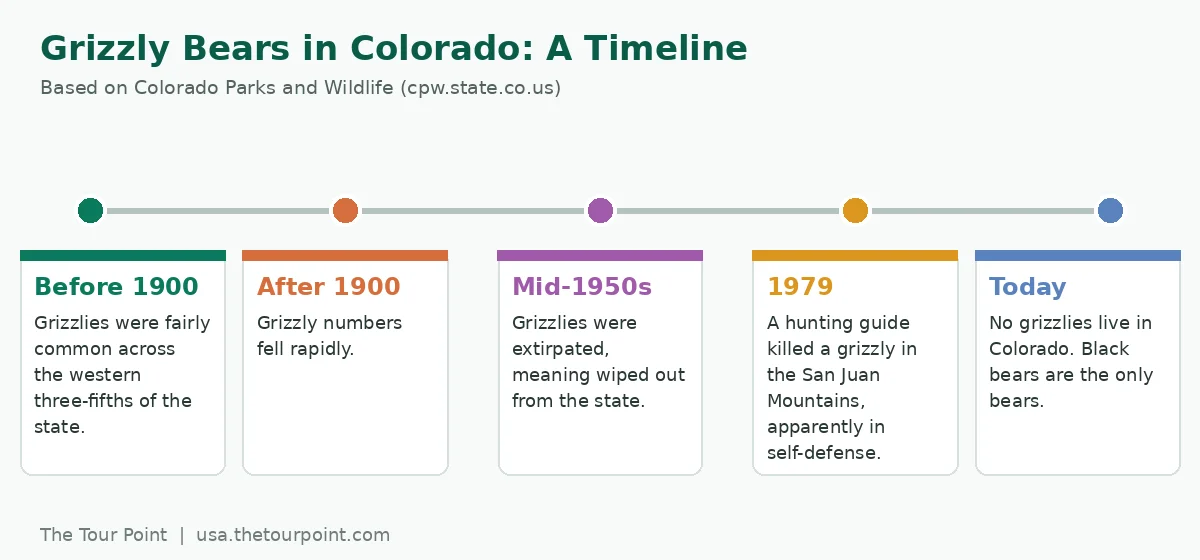 A timeline of grizzly bears in Colorado, based on Colorado Parks and Wildlife information.
After 1900, grizzly numbers fell rapidly. No grizzly was killed in the state between 1952 and 1979, and by the mid-1950s the species was considered gone. Then in 1979, a hunting guide killed a grizzly in the San Juan Mountains in what appears to have been self-defense. Naturalists were surprised, because they had assumed the bears were already extinct in Colorado. That bear is widely treated as the last one known in the state.
Why Did Grizzlies Disappear From Colorado?
CPW's records show the decline, but the causes are usually described in general terms. Settlement of the American West brought ranching, mining, trapping and hunting, and grizzlies were large animals that needed a lot of space. As people moved into their habitat, the bears lost both food sources and safe areas to live. Many were killed because they were seen as threats to livestock and people.
Grizzlies also reproduce slowly. Females first breed at around three and a half years old and then have cubs only every second or third winter, according to CPW. A population like that cannot recover quickly once adults are lost.
The 1979 Encounter in the San Juan Mountains
The 1979 event is the reason this question keeps coming up. Because it happened so late, many people reasonably wonder whether a few bears survived unnoticed. The San Juan Mountains are rugged, remote and lightly roaded, and they seem like they could support a bear. That makes the idea of hidden grizzlies appealing, but it remains an idea, not a documented fact.
What Bears Actually Live in Colorado?
Black bears are the only bears known to live in Colorado. CPW describes them as the largest carnivore left in the state now that grizzlies are gone. The agency estimates there are roughly 17,000 to 20,000 of them, and the population is described as stable and growing.
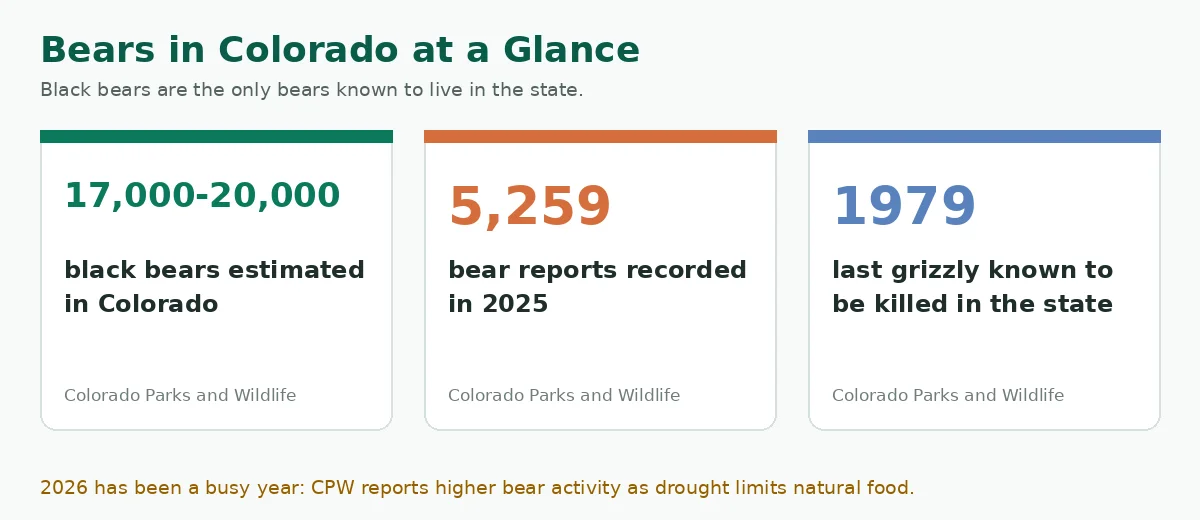 Bears in Colorado at a glance, using Colorado Parks and Wildlife figures.
The name can be misleading. According to the CPW black bear page, black bears can be honey-colored, blond, brown, cinnamon or black. This color range is the main reason people believe they have seen a grizzly. A light brown black bear, seen from far away or in poor light, can look like something much bigger and more dangerous than it is.
2026 Has Been an Unusually Busy Bear Year
Bear activity has risen in recent years. Reporting based on CPW data shows 5,259 bear reports in 2025, about 300 more than in 2024. In an August 2026 release, CPW said its officers were responding to higher than usual bear activity because drought conditions limited natural foods.
Local news also counted at least six reported bear attacks in Colorado by late August 2026. CPW said difficult food conditions can make bears act bolder as they look for food. Mountain towns have been affected too, with incidents reported in places such as Steamboat Springs and Aspen.
None of this means Colorado is unsafe to visit. It does mean that bear awareness matters more than usual right now, especially if you plan to hike, camp or stay in a mountain town.
Grizzly Bear vs. Black Bear: How to Tell the Difference
If you are ever unsure what you saw, look at body shape, not color. Color varies too much to trust.
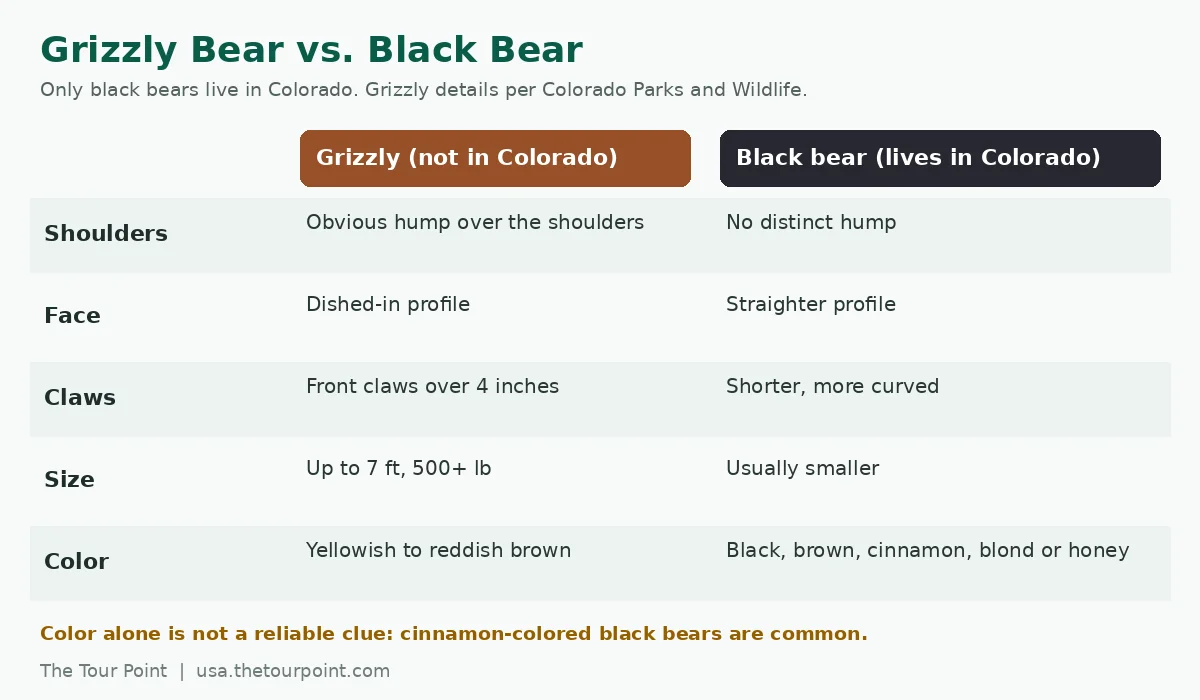 Grizzly bear vs. black bear: the features that matter most. Grizzly details come from Colorado Parks and Wildlife.
| Feature | Grizzly bear | Black bear |
|---|---|---|
| Shoulders | Clear hump over the shoulders | No distinct hump |
| Face | Dished-in profile | Straighter profile |
| Front claws | Over 4 inches long | Shorter and more curved |
| Size | Up to about 7 feet and 500 pounds or more | Usually smaller |
| Color | Yellowish to reddish brown | Black, brown, cinnamon, blond or honey |
The shoulder hump is the most reliable clue. A grizzly's hump is muscle used for digging, and it is clearly visible from the side. Black bears have a smoother back line. Grizzlies also have front legs that look longer than their rear legs, which is not true of black bears.
Where Can You See Grizzly Bears Instead?
If you want to see a grizzly, you have two realistic options: a zoo or sanctuary in Colorado, or a trip to a place where grizzlies live in the wild.
Grizzly Bears in Colorado Zoos and Sanctuaries
According to the Denver Gazette, grizzlies can be seen in the state at the Denver Zoo, the Cheyenne Mountain Zoo in Colorado Springs and The Wild Animal Sanctuary. Exhibits and hours change, so check each website before you go.
Where Grizzlies Live in the Wild
Wild grizzlies still live in parts of Wyoming, Montana and Idaho, including Yellowstone and Glacier National Park. If a wild grizzly is on your wish list, Glacier is a strong choice, and our guide to the best time to visit Glacier National Park explains when roads and trails are open and how to avoid the biggest crowds.
Grizzlies also live in the Canadian Rockies. If you are planning a longer mountain trip, see our guides to the best things to do in Banff, Canada and the best things to do in Jasper National Park.
Wherever you go, grizzly country has stricter safety expectations than Colorado. You usually need bear spray, careful food storage and a plan for what to do if you meet a bear.
Is It Safe to Hike in Colorado Bear Country?
Yes, for most people it is. CPW describes black bears as not naturally aggressive toward people, and most bears prefer to avoid contact. Most conflicts begin when bears find human food, garbage, pet food or bird seed, according to CPW's Living with Bears guidance.
That said, a bear that learns to get food around people can lose its natural caution. CPW says bears that repeatedly find food near homes may return to human areas. That is why food storage and clean campsites are the foundation of every set of bear safety tips.
Bear Safety Checklist
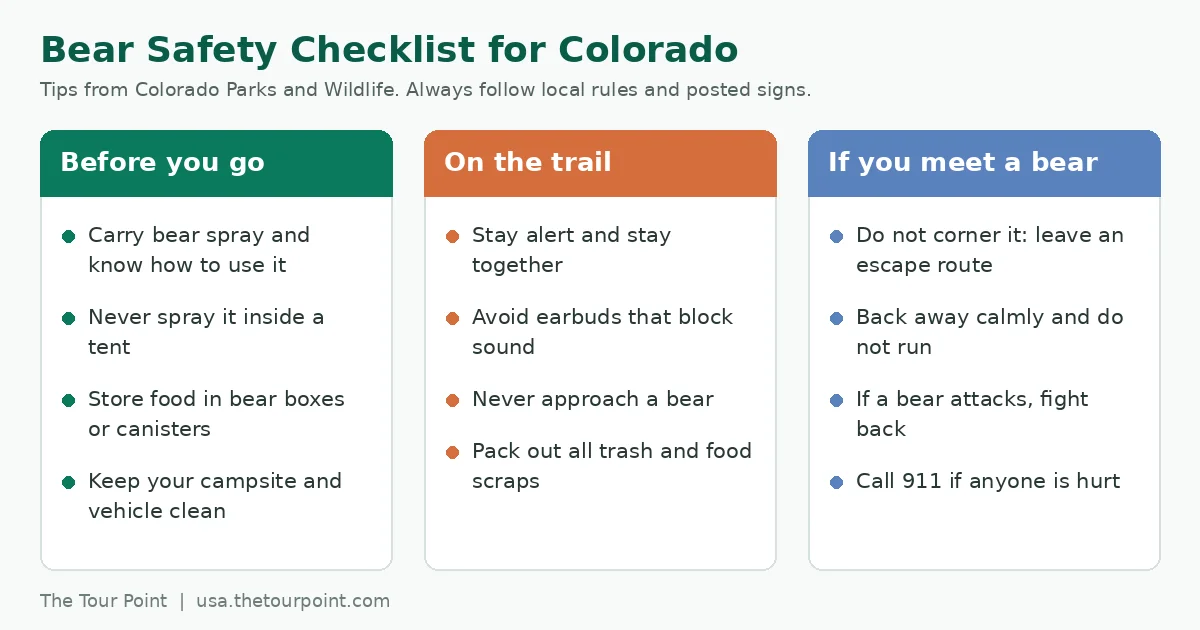 A bear safety checklist for Colorado hikers and campers, based on Colorado Parks and Wildlife tips.
These steps come from CPW and BearWise guidance:
- Carry bear spray. CPW recommends carrying bear spray or an air horn in the backcountry. Learn the directions on the canister before you need it, and never spray inside a tent.
- Stay alert and stay together. Watch your surroundings and avoid earbuds that block out sound.
- Store food properly. Use bear boxes, lockers or canisters, and keep scented items such as toiletries away from where you sleep.
- Keep camp and vehicle clean. Pack out all trash and food scraps, and set up camp away from dense cover and natural bear food sources.
- Respect signs and closures. Parks sometimes close trails after bear incidents, and those closures exist for good reasons.
What to Do if You See a Bear
Stay calm and do not approach. CPW officers advise against moving toward a bear, and there is no reason to turn and run. Give the bear space and an escape route, because a cornered animal is far more dangerous.
Back away slowly while facing the bear, speak in a calm voice, and keep dogs on a leash. If the bear follows you or acts aggressively, make yourself look larger, make noise and use bear spray if it gets close.
What to Do if a Bear Attacks
After any aggressive encounter, report it to your local CPW office, even if no one was hurt. CPW can then decide whether the bear poses an ongoing risk.
When Are Bears Most Active in Colorado?
Bears are active from spring through fall, and sightings usually rise through the summer. In the fall, bears search harder for food to prepare for winter, which is when many conflicts occur. A dry year, an early frost or a wildfire can reduce natural food and push bears toward campgrounds and neighborhoods.
If you are visiting during summer or fall, treat every hike and camp trip as bear country. That means checking local alerts, storing food correctly and carrying bear spray, even on popular trails near towns.
What to Pack for Bear Country
A short packing list helps you stay prepared without carrying too much:
- Bear spray, with the expiry date checked and a holster you can reach quickly
- A bear canister or a plan to use provided bear boxes
- An air horn or whistle for making noise
- Trash bags to pack out all waste
- A basic first aid kit and a charged phone with offline maps
- Layers and sturdy footwear, since mountain weather changes fast
Rules for canisters and food storage differ by park, forest and campground, so check the land manager's website before you go.
Planning a Colorado Mountain Trip?
If your plans take you to the high country, our guide to the best things to do in Aspen, Colorado covers a popular mountain town where bear awareness is part of everyday life. Salt Lake City is another good base for Rocky Mountain trips, and our best things to do in Salt Lake City, Utah guide is a good place to start.
Traveling with children? See our guide to the best things to do in the USA for a family vacation. Hiking alone? Read our list of the top 10 places to solo travel in the USA before you head into the backcountry. You can also browse all of our USA travel guides.
Are there grizzly bears in Colorado?
No. Colorado Parks and Wildlife says grizzly bears no longer live in the state. They were extirpated in the mid-1950s, and the last grizzly known to be killed in Colorado died in 1979 in the San Juan Mountains.
What bears live in Colorado?
Black bears are the only bears known to live in Colorado. They can be black, brown, cinnamon, blond or honey in color, and the state has roughly 17,000 to 20,000 of them.
When was the last grizzly bear seen in Colorado?
The last confirmed grizzly encounter in Colorado was in 1979, when a hunting guide killed a grizzly in the San Juan Mountains, apparently in self-defense. No sighting has been confirmed since.
Could grizzly bears still be living in the San Juan Mountains?
Some people believe a few might survive in remote areas, but no sighting has been confirmed in decades, and CPW says grizzlies no longer live in Colorado. You can report a possible sighting to CPW through its online form.
How can I tell a grizzly from a black bear?
Look for the shoulder hump, the dished-in face and the long front claws. Grizzlies have all three, while black bears have a smoother back, a straighter face and shorter claws. Color is not a reliable clue.
Where can I see grizzly bears near Colorado?
In Colorado, you can see grizzlies at zoos and sanctuaries such as the Denver Zoo and Cheyenne Mountain Zoo. To see wild grizzlies, you would need to travel to places such as Yellowstone or Glacier National Park.
Are black bears dangerous in Colorado?
Black bears are not naturally aggressive and usually avoid people, but they can be dangerous if they find human food or feel cornered. Store food properly, carry bear spray and never approach a bear.
What should I do if I find a bear at my campsite?
Do not approach it. Make noise from a safe distance, keep everyone together and secure all food. If the bear stays or acts aggressively, contact CPW or local authorities, and call 911 if anyone is hurt.
Grizzly bears no longer live in Colorado, but the state's black bears deserve respect, especially in a year of higher bear activity. Plan ahead, store your food, carry bear spray and enjoy the mountains with confidence.